Nginx in Production: Workers, Threads, and How a Request Finds Your Upstream
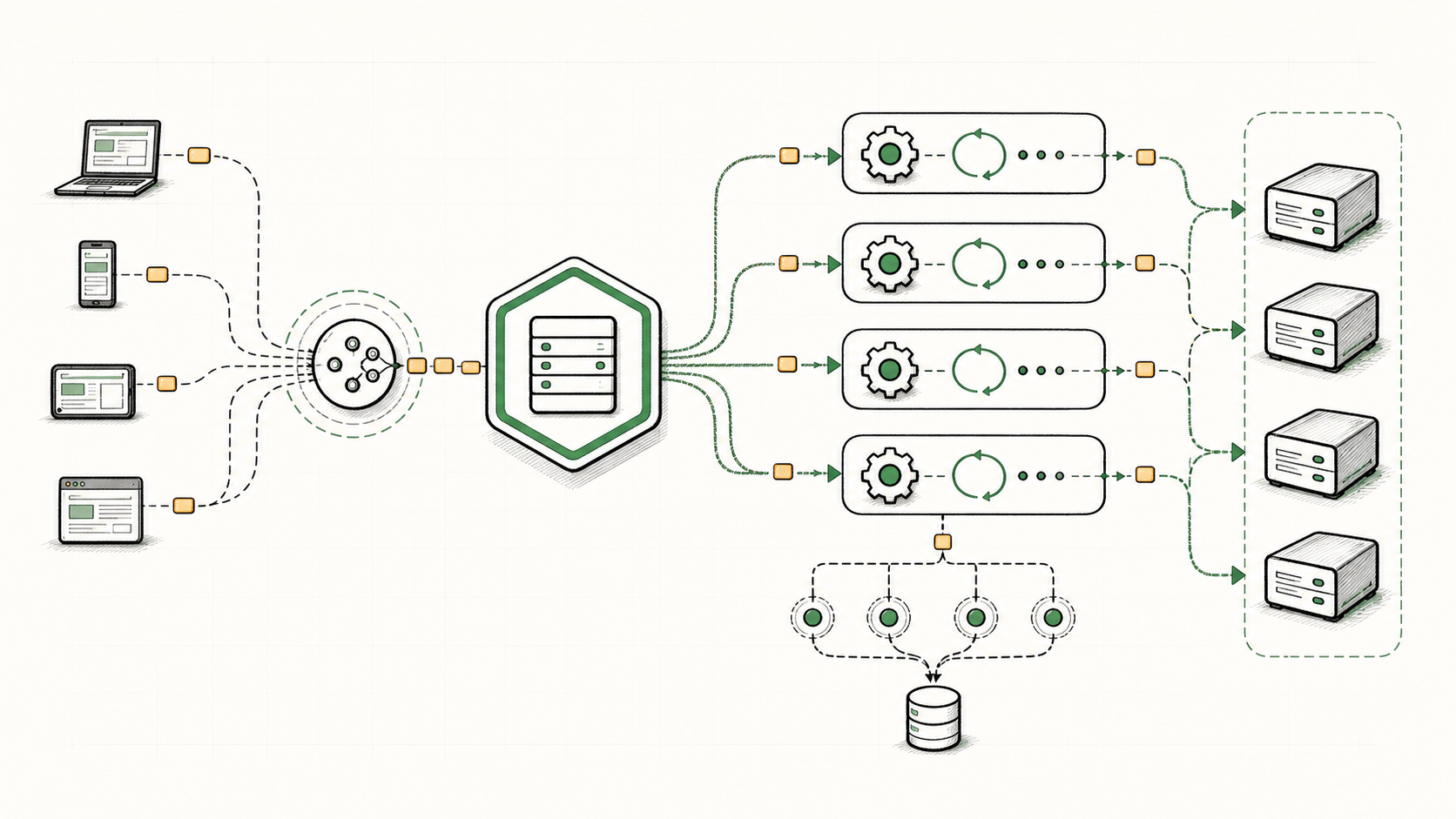
Nginx in Production: Workers, Threads, and How a Request Finds Your Upstream
$ ps aux | grep nginx
nginx: master process /usr/sbin/nginx
nginx: worker process
nginx: worker process
nginx: worker process
nginx: worker process
nginx: worker process
nginx: worker process
nginx: worker process
nginx: worker process
Nine of them.
On a box running one nginx.
Everyone says nginx is single threaded and async.
The same people also say thread pool.
Nine processes is neither of those things.
All three statements are true, and none of them are useful on their own.
This is the exact post I needed to read years ago.
The questions it answers:
If a worker is single threaded, what is worker_processes for?
If 8 workers listen on 443, who gets the connection?
Why does nginx keep sending traffic to a dead IP?
Why does reload not drop connections but restart does?
Should you just raise worker_connections, because that fixes everything bro?
Most posts answer one and stop.
Here is the whole flow.
nginx from outside
-> master process
-> worker processes
-> the event loop
-> who accepts the connection
-> where the threads actually are
-> the edge and anycast
-> upstream lookup
-> load balancing state
-> keepalive to upstream
-> reload
If that clicks, nginx stops looking like a config file with magic inside.
First, what is it doing
From outside:
client -> nginx -> backend
Internally, for one proxied request:

Each part has a job.
And its own way of embarrassing you later.
Master and workers
Start nginx and you do not get one nginx.
You get a master and N workers.
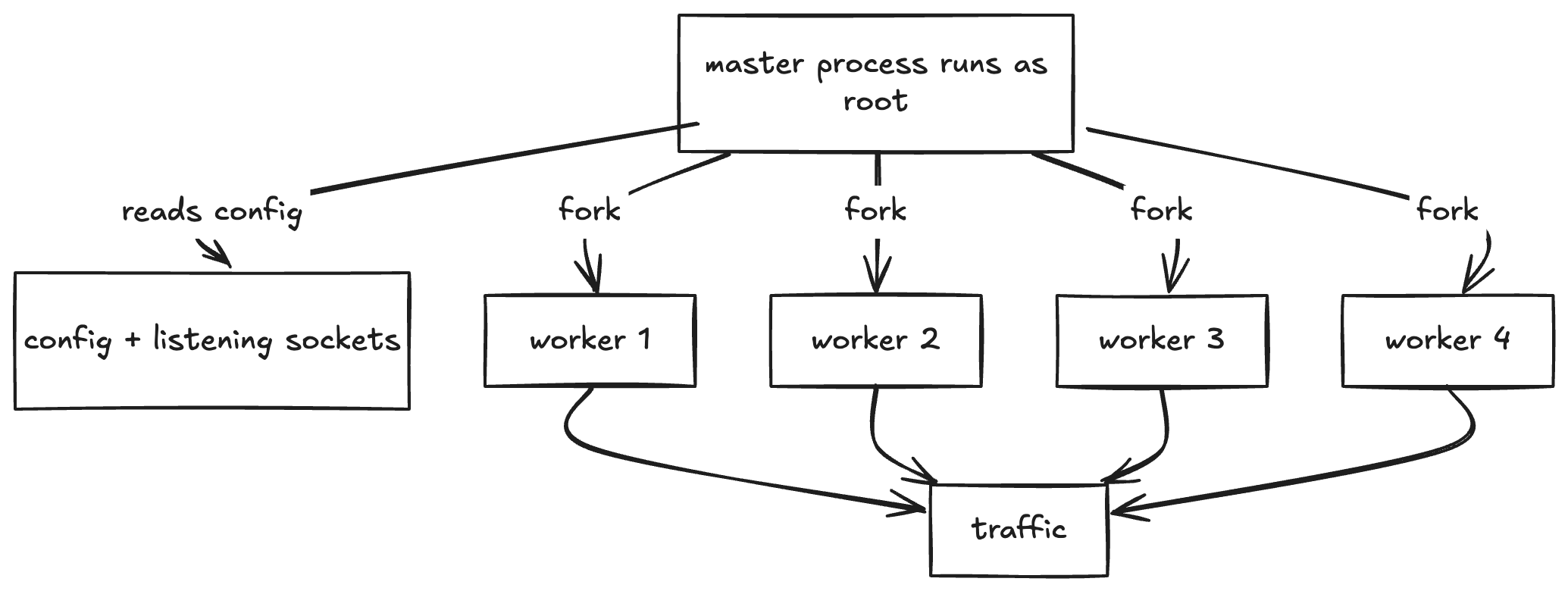
The master does not serve traffic.
It reads the config.
It binds the listening sockets.
Then it forks workers.
The master starts as root.
That is how it binds 80 and 443.
Workers drop to whatever the user directive says.
Workers serve every single request.
If you turn on proxy_cache, the master forks two more.
A cache manager, which trims the cache down to max_size on a timer.
And a cache loader, which reads existing cache metadata into shared memory at startup.
The loader runs once, then exits.
So a ps aux with caching on shows processes that are not workers and never touch a request.
First thing to get straight:
worker_processes = processes, not threads
worker_processes auto is one worker per core.
Not per connection.
Not per request.
Per core.
8 cores, 8 workers.
Those 8 processes handle everything.
One catch on auto.
It counts logical cores, not physical ones.
4 physical cores with hyper-threading reports 8.
So you get 8 workers on 4 real cores.
Worth knowing before you read anything into the number.
You can also pin each worker to a CPU:
worker_processes auto;
worker_cpu_affinity auto;
A pinned worker stops bouncing between cores.
So it keeps its CPU cache warm and skips some context switching.
The event loop
Each worker is single threaded.
Each worker runs an event loop.
On Linux that is epoll.
The worker asks the kernel which sockets are ready.
The kernel hands back the ready ones.
It does a little work on each.
Then asks again.
Again.
Again.
So no thread per connection.
A slow client costs almost nothing.
An FD and some state in memory.
But there is a strict rule.
A worker must never block.
Block for 200ms and that is not one slow request.
That is every connection it holds, waiting together.
That rule is the entire reason thread pools exist.
Who accepts the connection
This is where lot of folks get lost.
Every worker was forked from the master.
So every worker inherited the same listening socket.
All 8 can accept on 443.
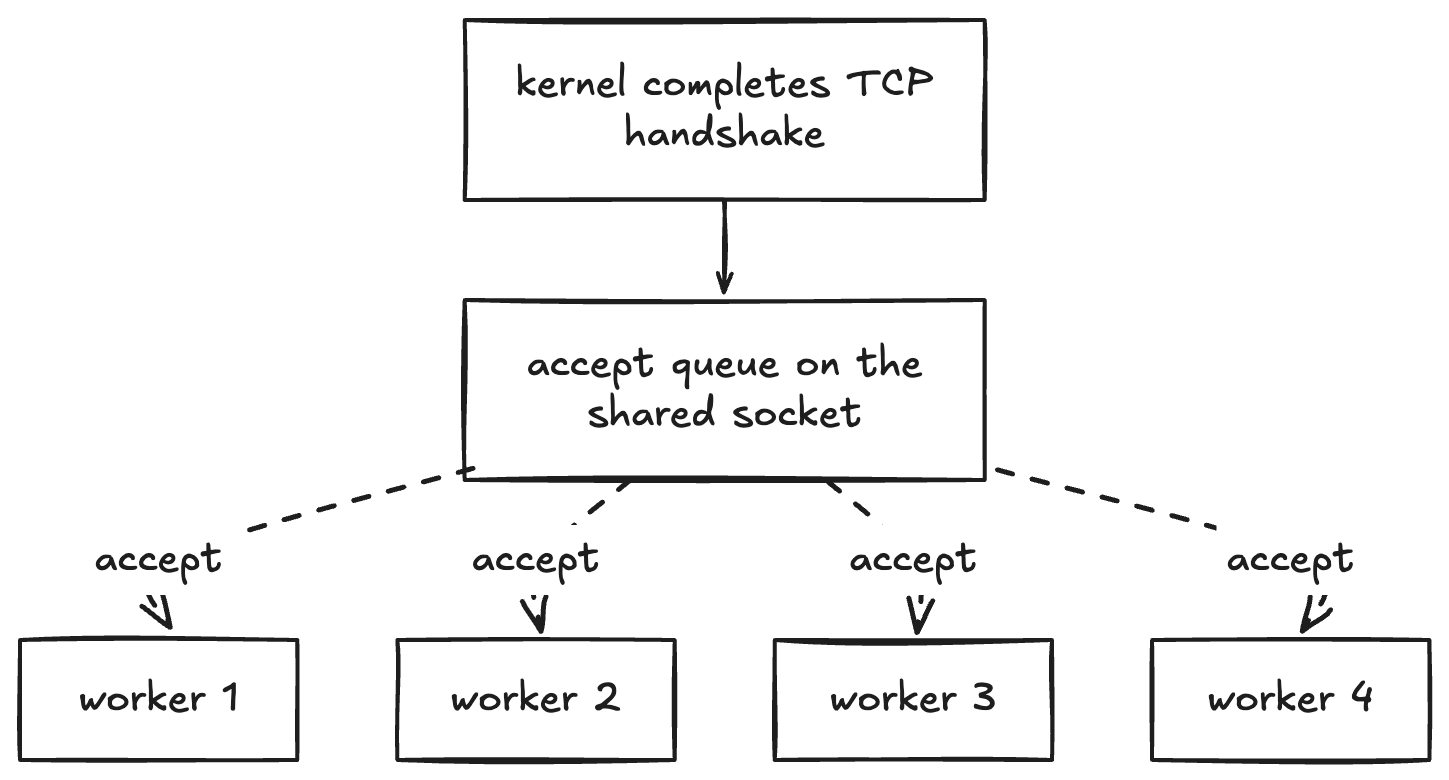
The frame that makes this click is the accept queue.
The kernel completes the TCP handshake by itself.
It parks the finished connection in a queue on that socket.
Nginx never touches the handshake.
Workers just pull from the queue.
So the question is not who handles the connection.
It is which worker gets to accept() it off the queue.
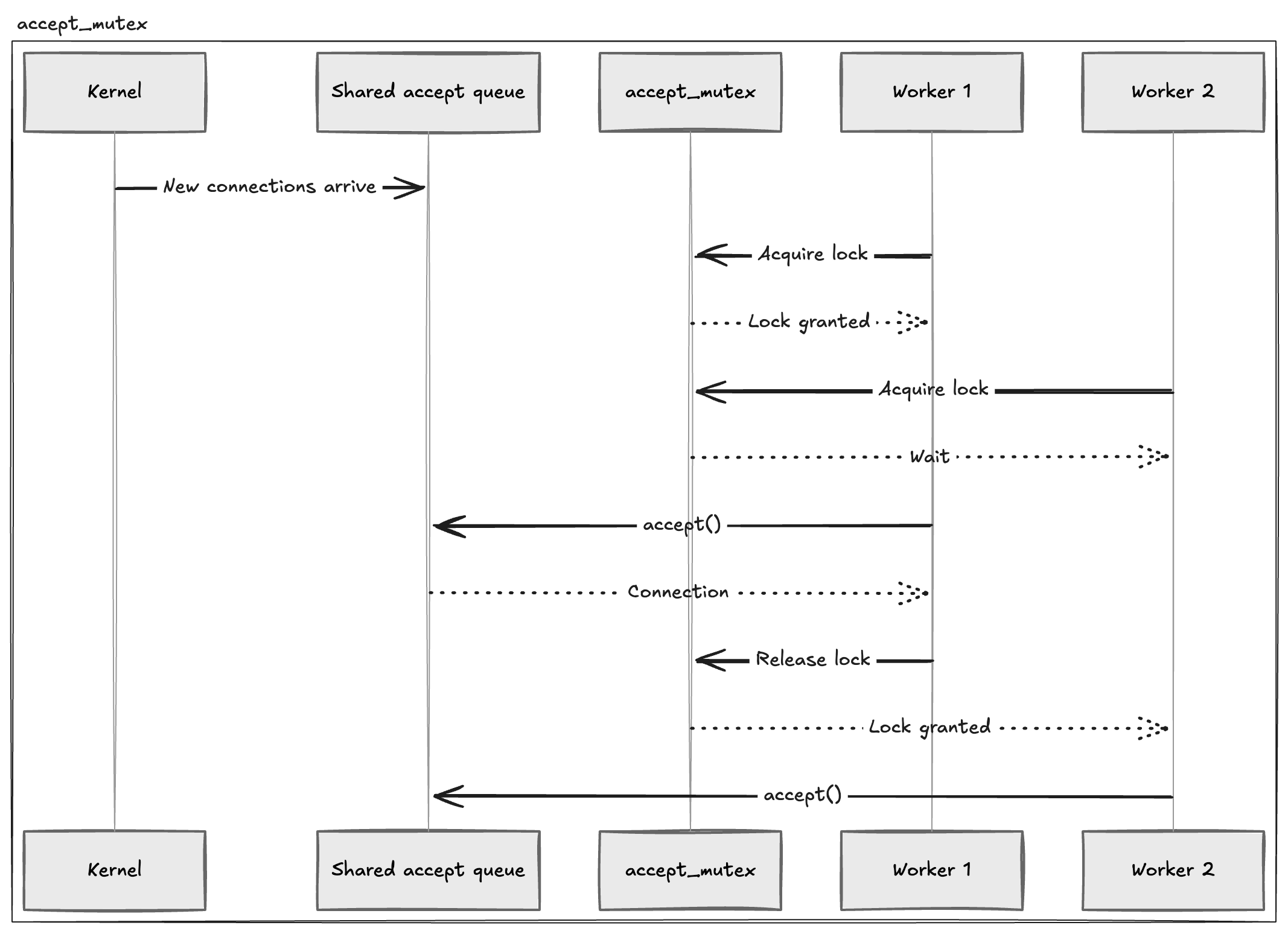
So who wins?
The old answer was accept_mutex.
Workers take turns holding a lock.
Only the holder accepts.
It existed for the thundering herd.
Kernel wakes all 8 for one connection.
7 find nothing.
They go back to sleep.
accept_mutex has defaulted to off since 1.11.3.
Modern kernels handle the wakeup better.
The better answer is reuseport:
listen 443 ssl reuseport;
That turns on SO_REUSEPORT.
Now each worker gets its own listening socket.
The kernel decides where a connection lands.
No userspace lock.
No herd.
Sounds free.
It is not.
The sockets are per worker.
So a reload has to make new ones.
Distribution in that window gets weird.
People have hit this on HTTP/3.
QUIC connections dropped across a reload.
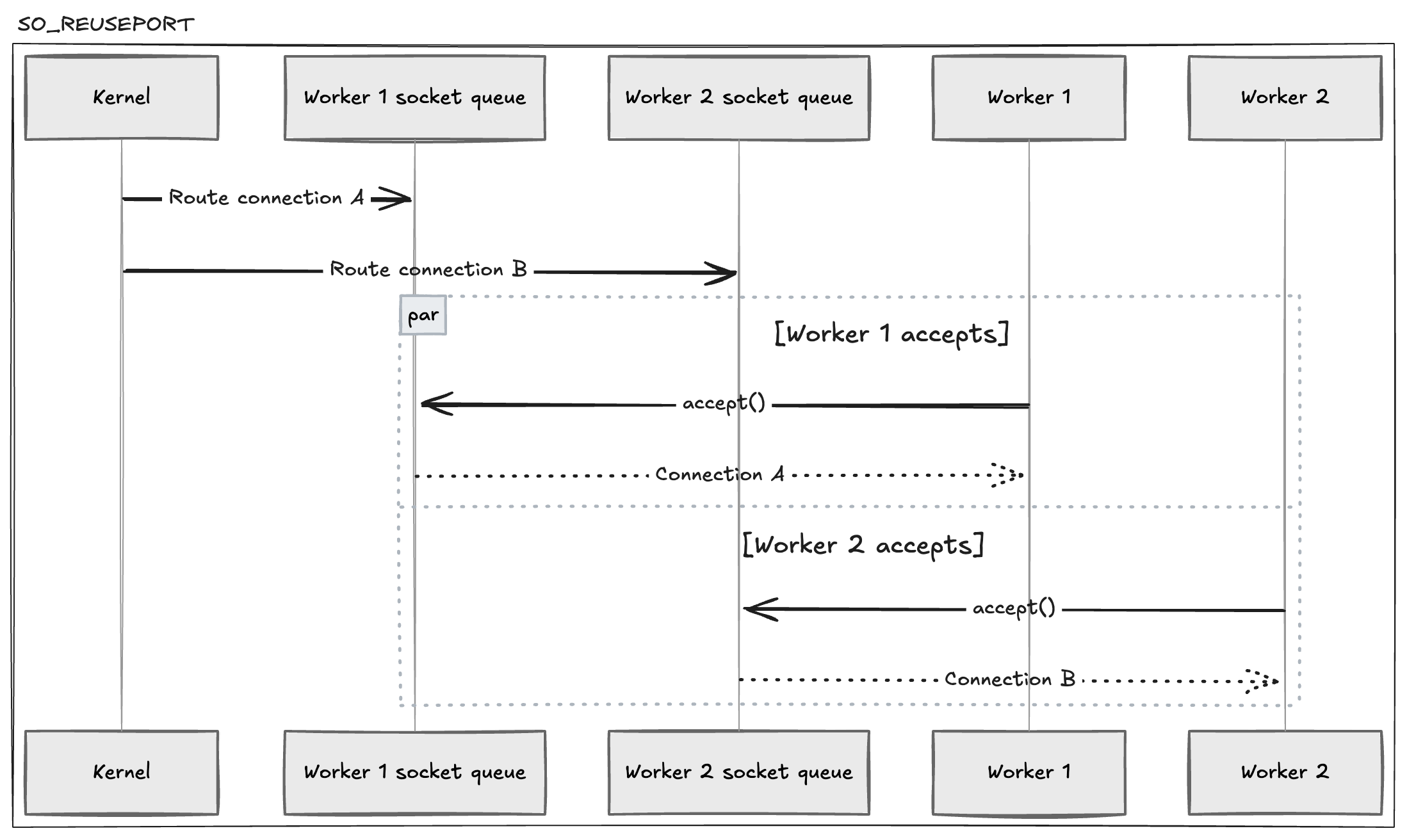
accept_mutex -> userspace fairness, mostly historical
reuseport    -> kernel balances, faster, reload gets sharper edges
So where are the threads
This is the part that gets repeated wrong.
"nginx is single threaded" is everywhere.
So is "nginx has a thread pool".
Both are true.
They are about different things.
The event loop is never threaded.
Networking stays in the loop.
The thread pool exists for one reason.
Blocking disk I/O.
A worker calls read() on a file that is not in page cache.
That call blocks.
Disk does not care about your event loop.
So since 1.7.11:
aio threads;
Now read and sendfile go to real OS threads.
The worker fires the request at the pool.
Then goes back to the loop.
It picks up the result later.
The Core Idea:

network I/O -> event loop, single threaded, never blocks
disk I/O    -> thread pool, so it can block somewhere harmless
It needs --with-threads at build time.
And it only helps when your files outgrow page cache.
Pure reverse proxy, it does nothing.
It is not a performance switch.
It is not a tuning knob.
It is a fix for one specific stall.
The edge and anycast
Behind Cloudflare, one IP is announced from many data centres.
BGP picks which one your packets reach.
Usually the network-closest.
Which is usually, not always, closest on a map.
The part that matters for your nginx:
Your nginx has nothing to do with any of it.
Anycast happens at the edge.
Your origin sees a small set of Cloudflare IPs.
TLS is terminated there and re-originated.
Connections get reused hard.
Which leads to the classic mistake:
limit_req_zone $remote_addr zone=one:10m rate=10r/s;
Behind Cloudflare, $remote_addr is Cloudflare.
You just rate limited a CDN.
Every user now shares a handful of buckets.
Nice.
You want set_real_ip_from with Cloudflare's ranges.
And real_ip_header CF-Connecting-IP.
Without that your logs describe the wrong entity.
So do your rate limits.
Upstream lookup
This one costs people real outages.
upstream backend {
    server api.internal.example.com:8080;
}
That hostname is resolved once, at config load.
Then cached for the life of the process.
The DNS TTL is irrelevant.
New IP on the backend, nginx keeps dialling the old one.
Until you reload.
Two more edges on the same thing.
If the name does not resolve at startup, nginx refuses to start.
host not found in upstream.
So a DNS blip during a deploy becomes a config error.
And a static proxy_pass caches the same way.
The open source workaround is to make the name dynamic:
resolver 10.0.0.2 valid=30s;
set $backend "api.internal.example.com";
proxy_pass http://$backend:8080;
With a variable there, nginx re-resolves on the resolver TTL.
Instead of caching forever.
You lose things this way.
The upstream block's load balancing, for one.
NGINX Plus has a resolve parameter that does it properly.
Everyone else picks between a variable, a sidecar, or reloading on change.
Load balancing state is per worker
Default is round robin.
You also get least_conn, ip_hash, hash, and random two.
But this is easy to miss.
Without a shared memory zone, upstream state lives inside each worker.
So on 8 workers, least_conn is 8 separate opinions.
Each worker only knows its own connections.
Same for max_fails and fail_timeout.
Same for per-server connection limits.
upstream backend {
    zone backend 64k;
    least_conn;
    server 10.0.0.11:8080;
    server 10.0.0.12:8080;
}
zone moves that state to shared memory.
Now every worker sees one truth.
Not a micro optimisation.
If you lean on least_conn or passive health checks, it is closer to a correctness fix.
Keepalive to upstream
This one changed recently.
If you learned nginx before 2026, your muscle memory is stale.
The snippet everyone used to paste:
proxy_http_version 1.1;
proxy_set_header Connection "";
Before 1.29.7, nginx spoke HTTP/1.0 to upstreams.
No persistent connections.
A fresh TCP handshake per request, unless you pasted that.
A lot of people never did.
And paid for it quietly, for years.
Since 1.29.7, in March 2026, upstreams default to HTTP/1.1 with keepalive.
The default is 32 idle connections per worker process.
Note the wording.
That is where people misread it.
keepalive 32 on 8 workers is not 32 idle connections.
It is up to 32 each.
And it caps the idle pool.
Not what nginx will open.
Under load it opens more.
It just does not keep the extras around.
And the per worker part is not a small detail.
Each worker keeps its own private upstream connection pool.
Processes do not share memory, so pooling across workers is hard by design.
8 workers is 8 pools that know nothing about each other.
Your upstream sees far more idle connections than it needs.
And your reuse ratio is worse than the config implies.
This is the exact reason Cloudflare stopped using nginx.
They wrote Pingora, in Rust, threaded instead of process based.
Threads share memory.
So Pingora runs one connection pool across every thread.
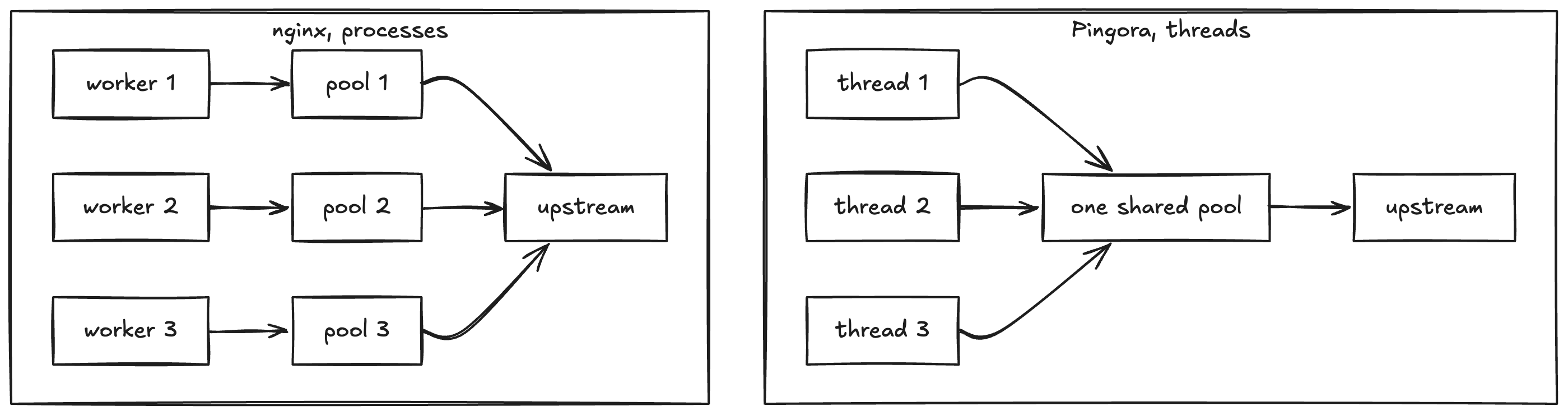
They reported a better reuse ratio and a real drop in new connections to origins.
Same problem you have on 8 workers.
They just had it at a scale where rewriting the proxy was cheaper than living with it.
Reload
nginx -s reload sends SIGHUP to the master.
The master re-reads and validates the config.
If it is broken, the old workers stay.
Nothing goes down.
That is genuinely nice.
If it is fine, the master spawns new workers.
Old workers stop accepting.
They finish what they hold.
So you briefly have two generations alive.
Running two different configs.
Old workers exit when their connections drain.
With keepalive clients, draining takes a while.
Those workers sit there holding the old config.
worker_shutdown_timeout keeps that bounded.
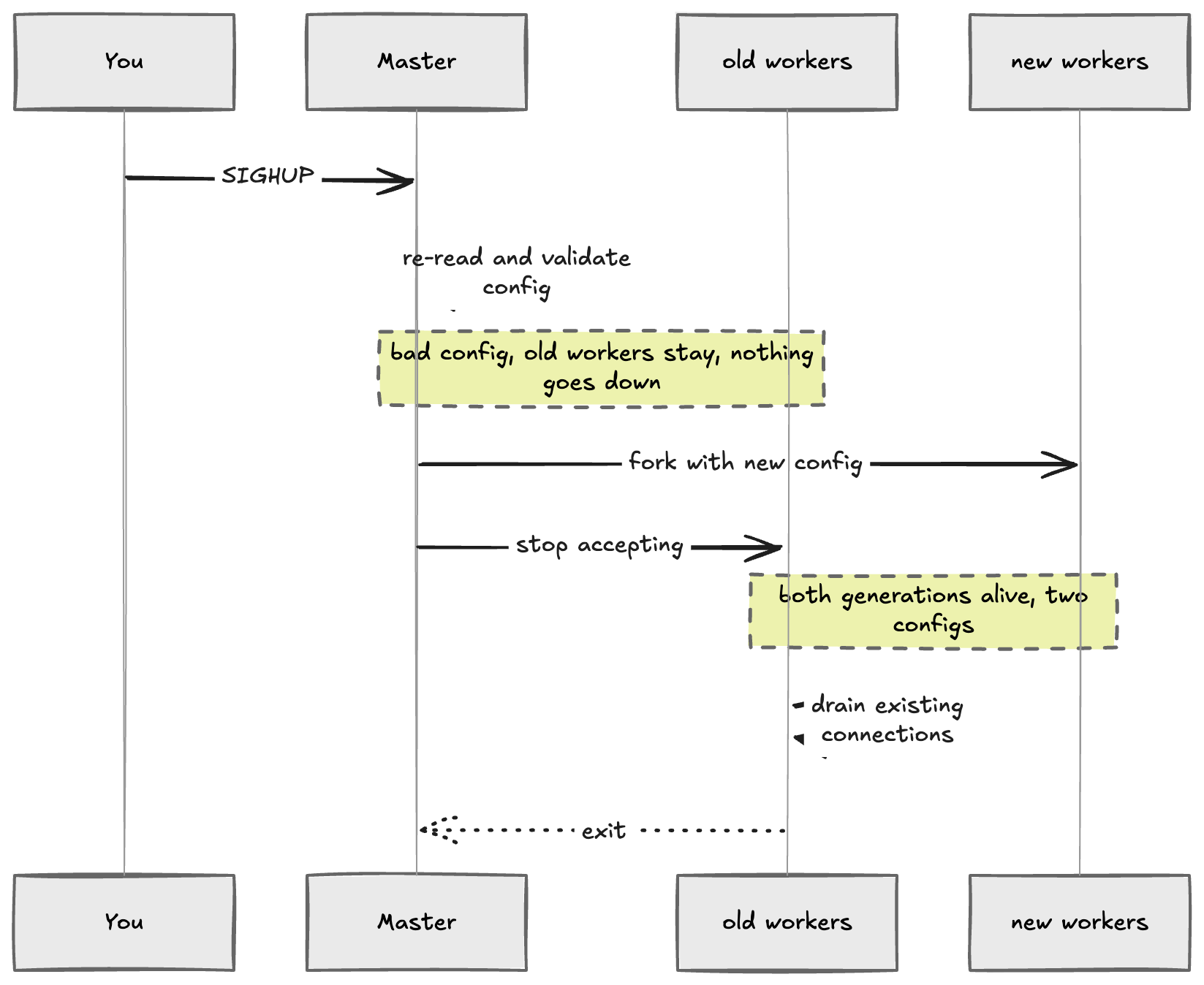
restart -> sockets closed, connections dropped
reload  -> new workers alongside old, old ones drain
The number people tune first
events {
    worker_connections 4096;
}
That is per worker.
So 8 workers is roughly 32,768 connections.
Except a proxied request uses two file descriptors.
One to the client, one to the upstream.
So your real proxy ceiling is about half.
Capped again by worker_rlimit_nofile.
And by the system limit under that.
Raising worker_connections past your FD limit gives you no capacity.
It gives you worker_connections exceed open file resource limit in the log.
The shape of it
Nginx has very few moving parts.
A master holding the config and the sockets.
One process per core, each spinning a loop that must not block.
A thread pool bolted on for the one unavoidable block.
And upstream decisions made once, at config load.
Then never revisited.
Almost every nginx surprise in production comes from that last line.
DNS resolved once and cached forever.
Load balancing state that is per worker.
A keepalive limit that is per worker and not global.
None of those are bugs.
They are answers to questions from 2004, still holding.
Decided by someone else, left as the default, inherited by you.
Which is most of production, honestly.
The config file is four lines and a proxy_pass.
Everything above is what those four lines actually mean.
Some of the framing here is borrowed. Hussein Nasser's NGINX Architecture and his NGINX Internal Architecture - Workers video are where the accept queue and the connection pool points came from. If this was useful, his stuff goes deeper.
Wriitten by a human among AI Agents